Summary (1997 - Dakar - Agades - Dakar)
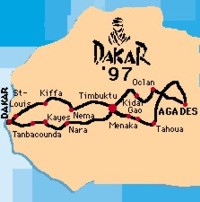 Dakar organiser Hubert Auriol, who had also planned the event in 1996, took a
completely new approach for 1997. A decision was made to change the rules and
to exclude all T3 prototypes from the competition for this year. The previous
years had shown the dominant performance of the high-tech machines, which were
increasingly being called the F1s of the desert. Auriol's intention was to give
Dakar organiser Hubert Auriol, who had also planned the event in 1996, took a
completely new approach for 1997. A decision was made to change the rules and
to exclude all T3 prototypes from the competition for this year. The previous
years had shown the dominant performance of the high-tech machines, which were
increasingly being called the F1s of the desert. Auriol's intention was to give
 all teams, whether professional or private, an equal chance of victory. Mitsubishi
started with three Pajeros and debuted a new Challenger, all of which belonged
to the T2 class. This year, 100 cars, 127 motorcycles and 55 trucks
set off from Dakar to race for 16 days through the scorching heat of four African
countries. For the first time in 19 years, the competition took place exclusively in Africa,
all teams, whether professional or private, an equal chance of victory. Mitsubishi
started with three Pajeros and debuted a new Challenger, all of which belonged
to the T2 class. This year, 100 cars, 127 motorcycles and 55 trucks
set off from Dakar to race for 16 days through the scorching heat of four African
countries. For the first time in 19 years, the competition took place exclusively in Africa,
 starting in Dakar and leading right across the continent to Agades. From
there it went back again to Dakar, with the drivers having to cross 8,000 km of the
toughest terrain the continent had to offer. The Mitsubishi team led
from the start, and when they reached Agades after 3,500 km of hard work, only
seconds separated the three leading Pajeros. The competition was tough for Mitsubishi,
starting in Dakar and leading right across the continent to Agades. From
there it went back again to Dakar, with the drivers having to cross 8,000 km of the
toughest terrain the continent had to offer. The Mitsubishi team led
from the start, and when they reached Agades after 3,500 km of hard work, only
seconds separated the three leading Pajeros. The competition was tough for Mitsubishi,
 and they were pressured not only by their rivals Jean-Louis Schlesser and Jutta Kleinschmidt
in their SEAT buggies, but also by Nissan, Toyota and the Korean
manufacturer Ssangyong. The hardest part of the rally began when the field reached Nema,
where team boss Ulrich Brehmer declared that from this point on the leading Pajero
could no longer be challenged. On Sunday, 19 January 1997, after 15
and they were pressured not only by their rivals Jean-Louis Schlesser and Jutta Kleinschmidt
in their SEAT buggies, but also by Nissan, Toyota and the Korean
manufacturer Ssangyong. The hardest part of the rally began when the field reached Nema,
where team boss Ulrich Brehmer declared that from this point on the leading Pajero
could no longer be challenged. On Sunday, 19 January 1997, after 15
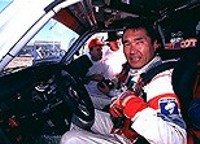 days and more than 8,000 km of the most demanding motorsport event in the world,
Kenjiro Shinozuka shot along the sandy beach near the capital of Senegal
and around the Pink Lake to add another chapter to the successes of the Mitsubishi team.
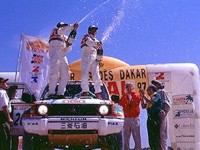
He became the very first Japanese driver ever to win the Dakar, and he did so
in the Mitsubishi Oil Ralliart Pajero of all cars. In the scorching heat of Senegal,
thousands of spectators began to cheer as the Japanese hero climbed onto the podium
with his French co-driver Henri Magne. It was a memorable performance by the Mitsubishi team,
whose cars made up the top 4 of the overall standings.
days and more than 8,000 km of the most demanding motorsport event in the world,
Kenjiro Shinozuka shot along the sandy beach near the capital of Senegal
and around the Pink Lake to add another chapter to the successes of the Mitsubishi team.
He became the very first Japanese driver ever to win the Dakar, and he did so
in the Mitsubishi Oil Ralliart Pajero of all cars. In the scorching heat of Senegal,
thousands of spectators began to cheer as the Japanese hero climbed onto the podium
with his French co-driver Henri Magne. It was a memorable performance by the Mitsubishi team,
whose cars made up the top 4 of the overall standings.
Final standings
| Pos. | No. | Driver | Manufacturer | Overall time |
| 1 | 205 | Shinozuka | Mitsubishi Pajero | 61.58.31 |
| 2 | 200 | Fontenay | Mitsubishi Pajero | + 00.04.16 |
| 3 | 202 | Saby | Mitsubishi Pajero | + 00.09.12 |
| 4 | 220 | Masuoka | Mitsubishi Challanger | + 02.25.27 |
| 5 | 206 | Kleinshcmidt | Schlesser Original | + 04.35.51 |
| 6 | 204 | Servia | Nissan | + 05.15.14 |
| 7 | 216 | Strugo | Mitsubishi Pajero | + 06.20.08 |
| 8 | 208 | Guedes | Nissan | + 09.23.13 |
| 9 | 268 | Argazzi | Nissan | + 09.40.41 |
| 10 | 224 | Souza | Mitsubishi Pajero | + 10.14.58 |