The Paris-Dakar

Summary
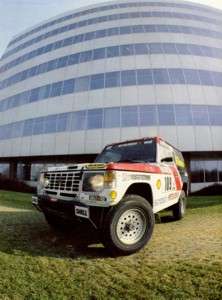
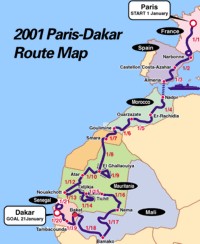
Since its first running in 1979, the Dakar has been regarded as the toughest motorsport event on the planet. Every year in the first week of January, hundreds of off-road enthusiasts set out with their works and privateer cars on a journey through one of the most inhospitable regions on earth - the Sahara. Stages of up to 500 km per day are covered, so that over the 14 days this event lasts, more than 2000 km quickly add up. Traditionally there is a one-day break in the middle of the rally, which is used for repairs and general recovery.

History
The rally was initiated and conceived by the French motorsportsman Thierry Sabine and was first held in 1978. Sabine had been inspired by his participation in the Abidjan-Nice rally, during which he got lost with his motorcycle in the Libyan desert in 1977. Sabine's much-quoted motto “If life gets boring, risk it!” found its fulfilment when he himself was killed on 14 January 1986 in a helicopter crash caused by a sandstorm during the Paris-Dakar Rally. In his memory, a hill covered with a small tree and some shrubbery was named Arbre Thierry Sabine. A memorial stone and an illustrated book kept there commemorate the accident (see web link below). Due to the large number of deaths among racers, spectators and the organisation team, the race repeatedly made headlines, but nevertheless (or perhaps for that very reason) developed into one of the best-known sporting events worldwide. Since its inception, the rally has claimed 51 human lives (as of 2006). Most recently, at the 2006 Dakar, the Australian motorcycle rider Andy Caldecott and two young spectators died. As a result, timekeeping was suspended on the final day of racing in 2006.