Summary (1998 - Paris - Gao - Dakar)
 For the second year in a row, Mitsubishi dominated the Paris-Dakar Rally
and filled the first four places of the overall standings with its machines. Mitsubishi
also managed to win the marathon classification for production-based vehicles
once again at the 20th running of the rally. After many luckless attempts, the
Frenchman Jean-Pierre Fontenay succeeded this year in winning the rally for himself,
taking victory in his Off-Road Express Mitsubishi Ralliart Pajero. Everyone agreed
that this Dakar was one of the toughest anyone could remember, for it
For the second year in a row, Mitsubishi dominated the Paris-Dakar Rally
and filled the first four places of the overall standings with its machines. Mitsubishi
also managed to win the marathon classification for production-based vehicles
once again at the 20th running of the rally. After many luckless attempts, the
Frenchman Jean-Pierre Fontenay succeeded this year in winning the rally for himself,
taking victory in his Off-Road Express Mitsubishi Ralliart Pajero. Everyone agreed
that this Dakar was one of the toughest anyone could remember, for it
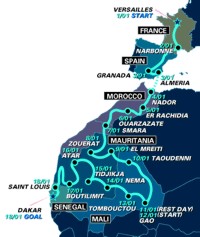
 led over 10,000 km through the African continent. For 18 days, the victory was
fought out over 6,338 km of racing between Paris and Senegal, with the rally
caravan crossing France, Spain, Morocco, Mauritania, Mali and
Senegal. The worst part was the massive three marathon days, in which the
cars, trucks and motorcycles had to cross the toughest terrain in the world and
were not allowed to accept any help from their flying technicians. From the start,
as the rally led over relatively short special stages in Europe, it became clear
that the Mitsubishis would dominate this year's running of the Dakar. When the
rally then crossed the Mediterranean and continued in Morocco,
led over 10,000 km through the African continent. For 18 days, the victory was
fought out over 6,338 km of racing between Paris and Senegal, with the rally
caravan crossing France, Spain, Morocco, Mauritania, Mali and
Senegal. The worst part was the massive three marathon days, in which the
cars, trucks and motorcycles had to cross the toughest terrain in the world and
were not allowed to accept any help from their flying technicians. From the start,
as the rally led over relatively short special stages in Europe, it became clear
that the Mitsubishis would dominate this year's running of the Dakar. When the
rally then crossed the Mediterranean and continued in Morocco,
 the French team PIAA Mitsubishi with its drivers Bruno Saby and Dominique
Serieys demonstrated the full potential of the Pajero and extended its lead over
the entire field considerably. Although Saby was put under pressure by his teammates
Shinozuka and Fontenay, he kept the lead until the rally met the sand of the Sahara
at the southern border of Morocco and the first marathon sections began.
Shinozuka and Saby suffered from gearbox problems as they travelled the old trading route
between Morocco and Timbuktu. They were on their way to the start of the first
marathon section in the town of Zouerat in the heart of the Sahara. On this stretch,
Fontenay took the lead, which he did not give up again until the finish. As the motorised
the French team PIAA Mitsubishi with its drivers Bruno Saby and Dominique
Serieys demonstrated the full potential of the Pajero and extended its lead over
the entire field considerably. Although Saby was put under pressure by his teammates
Shinozuka and Fontenay, he kept the lead until the rally met the sand of the Sahara
at the southern border of Morocco and the first marathon sections began.
Shinozuka and Saby suffered from gearbox problems as they travelled the old trading route
between Morocco and Timbuktu. They were on their way to the start of the first
marathon section in the town of Zouerat in the heart of the Sahara. On this stretch,
Fontenay took the lead, which he did not give up again until the finish. As the motorised
 competition had to struggle with technical problems, the terrain alone remained the challenger
for the Mitsubishis. Near the town of Gao, Shinozuka then dropped back to fourth
place after digging himself into the soft dune sand, while Saby and
Fontenay, separated by only minutes, fought a thrilling head-to-head race.
It was a historic battle and only 10 minutes lay between Saby and Fontenay,
while the rest of the field had fallen more than an hour behind. After a
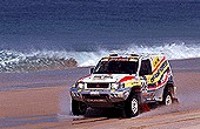
sprint of just 18 km across the beaches of the Pink Lake, near Dakar, Fontenay's
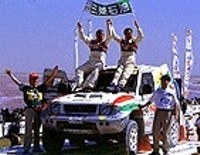
Pajero shot over the finish ramp first of the whole rally caravan to the applause
of thousands of spectators. It was a happy moment for Fontenay and he dedicated the victory
to his long-time navigator and friend Bruno Mussmarra. With the victories of the previous year
and the outstanding performance at this Dakar, Mitsubishi had once again proven
that the Pajero was the king of the desert.
competition had to struggle with technical problems, the terrain alone remained the challenger
for the Mitsubishis. Near the town of Gao, Shinozuka then dropped back to fourth
place after digging himself into the soft dune sand, while Saby and
Fontenay, separated by only minutes, fought a thrilling head-to-head race.
It was a historic battle and only 10 minutes lay between Saby and Fontenay,
while the rest of the field had fallen more than an hour behind. After a
sprint of just 18 km across the beaches of the Pink Lake, near Dakar, Fontenay's
Pajero shot over the finish ramp first of the whole rally caravan to the applause
of thousands of spectators. It was a happy moment for Fontenay and he dedicated the victory
to his long-time navigator and friend Bruno Mussmarra. With the victories of the previous year
and the outstanding performance at this Dakar, Mitsubishi had once again proven
that the Pajero was the king of the desert.
Final standings
| Pos. | No. | Driver | Manufacturer | Overall time |
| 1 |
|
Fontenay | Mitsubishi Pajero | 65.25.58 |
| 2 |
|
Shinozuka | Mitsubishi Pajero | + 01.45.44 |
| 3 |
|
Saby | Mitsubishi Pajero | + 01.59.01 |
| 4 |
|
Masuoka | Mitsubshi Challanger | + 05.55.27 |
| 5 |
|
Schlesser | Schlesser Original | + 08.10.39 |
| 6 |
|
Alliot | Nissan | + 11.39.43 |
| 7 |
|
Housieaux | Nissan | + 13.20.24 |
| 8 |
|
De Lavergne | Nissan | + 13.52.15 |
| 9 |
|
Prieto | Mitsubishi Montero | + 17.42.50 |
| 10 |
|
Ten Harkel | Mitsubishi Pajero | + 23.28.05 |