Summary (2000 - Paris - Dakar - Cairo)
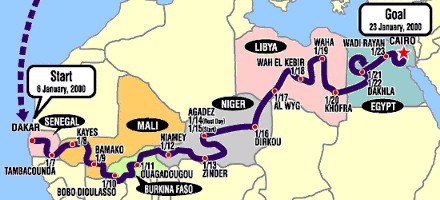
 The Dakar 2000 was intended to be one of the most challenging rallies ever, and so
a completely new route was planned, leading from Dakar in Senegal right across the
African continent and ending in Cairo. In between, 7,626
km of special stages and 10,905 km of total distance, with passages over 800 km long,
had to be overcome. After the cars had been shipped from Paris to Dakar, it seemed
as if the Pajeros would once again put their stamp on the race. Despite the
high speeds the route was demanding, and so technique and
driving skill were in greater demand than the car. The Mitsubishis took turns
at the front, separated only by minutes. For Fontenay, misfortune took
its course when he took a wrong turn near Burkina Faso and got completely lost.
The Dakar 2000 was intended to be one of the most challenging rallies ever, and so
a completely new route was planned, leading from Dakar in Senegal right across the
African continent and ending in Cairo. In between, 7,626
km of special stages and 10,905 km of total distance, with passages over 800 km long,
had to be overcome. After the cars had been shipped from Paris to Dakar, it seemed
as if the Pajeros would once again put their stamp on the race. Despite the
high speeds the route was demanding, and so technique and
driving skill were in greater demand than the car. The Mitsubishis took turns
at the front, separated only by minutes. For Fontenay, misfortune took
its course when he took a wrong turn near Burkina Faso and got completely lost.
 On top of that, his Pajero was plagued by brake problems. After the sixth
stage, Shinozuka led by 6m 15s over second-placed Jean-Louis Schlesser. From then on the rally
changed its face, for now the stages began in the Sahel pre-desert,
where the dusty bush ends and the first sand dunes along the Niger
appear. The Mitsubishis fought doggedly, but then the first
of two disasters occurred. Heavy terrorist activity was reported from Niger,
and the organisation, concerned for the safety of the rally community, cancelled
the next five days of the rally. That was the first time in the 22-year history
of the Dakar that such a thing had happened. Three Russian Antonov 127 aircraft were brought in
and the 336 vehicles and 1,365 participants were flown within five days to Sabah
in Libya, where the rally was continued on 17 January with the real desert stages.
The second misfortune occurred when, on the 12th stage, enormous downpours
On top of that, his Pajero was plagued by brake problems. After the sixth
stage, Shinozuka led by 6m 15s over second-placed Jean-Louis Schlesser. From then on the rally
changed its face, for now the stages began in the Sahel pre-desert,
where the dusty bush ends and the first sand dunes along the Niger
appear. The Mitsubishis fought doggedly, but then the first
of two disasters occurred. Heavy terrorist activity was reported from Niger,
and the organisation, concerned for the safety of the rally community, cancelled
the next five days of the rally. That was the first time in the 22-year history
of the Dakar that such a thing had happened. Three Russian Antonov 127 aircraft were brought in
and the 336 vehicles and 1,365 participants were flown within five days to Sabah
in Libya, where the rally was continued on 17 January with the real desert stages.
The second misfortune occurred when, on the 12th stage, enormous downpours

 and cold turned the sandy route into solid motorways. The Dakar transformed
from a rally into a high-speed race, and so two or three hundred
kilometres were covered at top speed. A catastrophe for the Mitsubishis,
for the buggies, more than 600 kg lighter, were now vastly superior and
pulled away. The high speed soon demanded a price, however, and
four vehicles rolled over while jumping the crest of a dune. Among the crashed
cars were three Mitsubishis, piloted by Shinozuka, Sousa and Prieto.
The fourth car was a Nissan with Gregoire de Mevius at the
wheel. A helicopter of the medical team took the drivers and navigators to
hospital and the rally continued without the four. Team Mitsubishi France
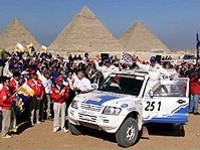
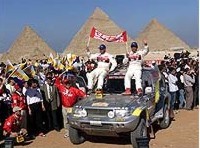
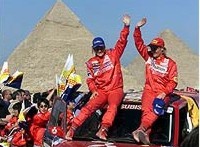
celebrated a very good third place at the Dakar 2000 on arrival in Cairo,
after pushing their Pajeros to the limit, for the Dakar 2000 was one
of the fastest there had ever been, which above all benefited the light Schlesser
buggy, which then also rolled through the finish first. After the rally,
the drivers agreed that the rally was unfortunately one of the fastest there
had ever been. Driving skill was neglected after the first half.
Nevertheless, the Dakar 2000 was a spectacular event with as many highs
and lows as a thriller.
and cold turned the sandy route into solid motorways. The Dakar transformed
from a rally into a high-speed race, and so two or three hundred
kilometres were covered at top speed. A catastrophe for the Mitsubishis,
for the buggies, more than 600 kg lighter, were now vastly superior and
pulled away. The high speed soon demanded a price, however, and
four vehicles rolled over while jumping the crest of a dune. Among the crashed
cars were three Mitsubishis, piloted by Shinozuka, Sousa and Prieto.
The fourth car was a Nissan with Gregoire de Mevius at the
wheel. A helicopter of the medical team took the drivers and navigators to
hospital and the rally continued without the four. Team Mitsubishi France
celebrated a very good third place at the Dakar 2000 on arrival in Cairo,
after pushing their Pajeros to the limit, for the Dakar 2000 was one
of the fastest there had ever been, which above all benefited the light Schlesser
buggy, which then also rolled through the finish first. After the rally,
the drivers agreed that the rally was unfortunately one of the fastest there
had ever been. Driving skill was neglected after the first half.
Nevertheless, the Dakar 2000 was a spectacular event with as many highs
and lows as a thriller.
Final standings
| Pos. | No. | Driver | Manufacturer | Overall time |
| 1 | 250 | Schlesser | Schlesser Renault | 45.06.03 |
| 2 | 270 | Peterhansel | Mega Desert | + 00.12.33 |
| 3 | 251 | Fontenay | Mitsubishi Pajero | + 00.27.33 |
| 4 | 253 | Servia | Schlesser Renault | + 00.38.50 |
| 5 | 256 | Kleinschmidt | Mitsubishi Pajero | + 01.09.00 |
| 6 | 271 | Masuoka | Mitsubishi Pajero | + 01.41.12 |
| 7 | 252 | Saby | Protruck | + 02.43.15 |
| 8 | 255 | De Lavergne | Nissan Terrano | + 03.39.28 |
| 9 | 276 | Pescarolo | Nissan Terrano | + 05.03.10 |
| 10 | 283 | Vila Altimir | Nissan Patrol | + 06.46.26 |