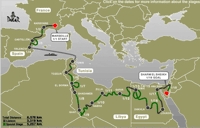
Summary (2003 - Marseille - Sharm El Sheik)
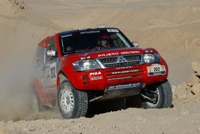
 At the 2001 show in Frankfurt, it could already be eyed at the Mitsubishi stand: the
civilian version of the Pajero Evolution. With the racing version of the Evolution, the
Japanese development department of its builders achieved a gigantic coup, for they
brought the new Pajero through the Dakar alive with virtually no lead time — and even
into first place. The new cat dominated the race at will from the start.
Yet beforehand things had not looked all that rosy. In 2003, no fewer than three
At the 2001 show in Frankfurt, it could already be eyed at the Mitsubishi stand: the
civilian version of the Pajero Evolution. With the racing version of the Evolution, the
Japanese development department of its builders achieved a gigantic coup, for they
brought the new Pajero through the Dakar alive with virtually no lead time — and even
into first place. The new cat dominated the race at will from the start.
Yet beforehand things had not looked all that rosy. In 2003, no fewer than three
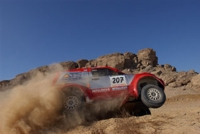
 new developments took the start: the BMW X5, the Volkswagen Tarek and the Mitsubishi
Evolution. None of the supporting teams had much experience with the durability
and handling of the vehicles, and yet they were sent over the murderous routes
of the most unforgiving sand desert on this earth. All three newcomers held their
own with flying colours. The X5s in particular stood out positively with their durability
and their top speed. But the new Evolution beat everyone by a long way, and the
year 2003 became the fifth (1992, 1997, 1998, 2002) in which Mitsubishi took the first
new developments took the start: the BMW X5, the Volkswagen Tarek and the Mitsubishi
Evolution. None of the supporting teams had much experience with the durability
and handling of the vehicles, and yet they were sent over the murderous routes
of the most unforgiving sand desert on this earth. All three newcomers held their
own with flying colours. The X5s in particular stood out positively with their durability
and their top speed. But the new Evolution beat everyone by a long way, and the
year 2003 became the fifth (1992, 1997, 1998, 2002) in which Mitsubishi took the first
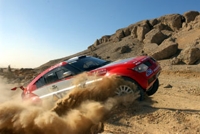
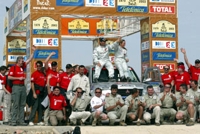
 three places. And as if that were not enough, the Mitsubishi drivers won 11
of 16 stages. Masuoka, as in the previous year, gave a perfect performance
and drove for all he was worth. So in the end he emerged as the laughing winner of
the desert battle, with a lead of one hour and fifty-two minutes
over the runner-up (also a Mitsubishi): "I am so happy to have won the 25th
Dakar. It was a great race this year; it was fast and
there were some good stages in Tunisia and Libya. It was pretty tough. Every
day we drove between 160 and 180 km/h and it was exciting to race against Stephane,
three places. And as if that were not enough, the Mitsubishi drivers won 11
of 16 stages. Masuoka, as in the previous year, gave a perfect performance
and drove for all he was worth. So in the end he emerged as the laughing winner of
the desert battle, with a lead of one hour and fifty-two minutes
over the runner-up (also a Mitsubishi): "I am so happy to have won the 25th
Dakar. It was a great race this year; it was fast and
there were some good stages in Tunisia and Libya. It was pretty tough. Every
day we drove between 160 and 180 km/h and it was exciting to race against Stephane,
 but in the second half we were more careful and reduced our speed
to spare our cars", enthused a grinning Masuoka after the tour. The
1998 winner Jean-Pierre Fontenay and his long-time co-driver Gilles Picard
finished "only" in 2nd place this time, after denting the front of their 2002 Pajero
in an overconfident jump over the crest of a dune and only being able to continue
after a makeshift repair. After the race, Fontenay showed himself
a little disappointed about Stephane Peterhansel's "11-hour problem",
but in the second half we were more careful and reduced our speed
to spare our cars", enthused a grinning Masuoka after the tour. The
1998 winner Jean-Pierre Fontenay and his long-time co-driver Gilles Picard
finished "only" in 2nd place this time, after denting the front of their 2002 Pajero
in an overconfident jump over the crest of a dune and only being able to continue
after a makeshift repair. After the race, Fontenay showed himself
a little disappointed about Stephane Peterhansel's "11-hour problem",
 as he had been looking forward to a hard fight with him. Third-placed Stephane Peterhansel,
who led the field for a large part of the rally, robbed himself of victory when,
on the penultimate day, he rammed a rock while overtaking a truck and shredded his
front suspension. As a consequence of the accident he lost three hours,
which he had to spend waiting for the service truck. The Telefonica Dakar Rally 2003 was
once again a suspense-filled drama in the African desert, and Mitsubishi proved
once more that the Pajero deserves the title: King of the Desert.
as he had been looking forward to a hard fight with him. Third-placed Stephane Peterhansel,
who led the field for a large part of the rally, robbed himself of victory when,
on the penultimate day, he rammed a rock while overtaking a truck and shredded his
front suspension. As a consequence of the accident he lost three hours,
which he had to spend waiting for the service truck. The Telefonica Dakar Rally 2003 was
once again a suspense-filled drama in the African desert, and Mitsubishi proved
once more that the Pajero deserves the title: King of the Desert.
Final standings
| Pos. | No. | Driver | Manufacturer | Overall time |
| 1 |
|
Masuoka | Mitsubishi Pajero | 49.08.52 |
| 2 |
|
Fontenay | Mitsubishi Pajero | + 01.52.12 |
| 3 |
|
Peterhansel | Mitsubishi Pajero | + 02.16.28 |
| 4 |
|
Sousa | Mitsubishi L200 Strakar | + 02.27.47 |
| 5 |
|
De Villiers | Nissan Pick Up | + 02.45.55 |
| 6 |
|
Henrard | Volkswagen Tarek | + 03.42.15 |
| 7 |
|
Vatanen | Nissan Pick Up | + 04.25.59 |
| 8 |
|
Kleinschmidt | Volkswagen Tarek | + 08.16.56 |
| 9 |
|
Alphand | BMX X5 | + 08.56.06 |
| 10 |
|
Monterde | Mitsubishi Pajero | + 09.08.06 |