L040
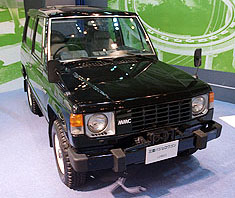
General Information
The year was 1983 when the Mitsubishi Pajero, then in the L040 body style, first put its wheels on European - or more precisely, German - soil. At that time most other off-roaders were still angular, comfortless and rather spiritless tanks bearing the label durable and robust. The Pajero made no compromises when it came to quality and reliability, yet it paid more attention to comfort than all the others. This shows in details such as: counter-rotating balance shafts, front independent suspension and a headlight washer system. Nowadays these accessories seem antiquated, but back then they were the non-plus-ultra of the off-road scene. Mocked by the other off-road manufacturers for its independent front suspension, the Pajero taught its competition the meaning of fear when it acquitted itself with flying colours at the Paris-Dakar and stole the show from all the other manufacturers.
Initially the Pajero was only available in three variants, all with a short wheelbase and two doors. The petrol version came in steel-roof and soft-top configurations, the diesel exclusively with a steel roof. With a length of just 3935 mm and a 2350 mm wheelbase, the turning circle came to 11.2 metres, roughly Golf Mk I dimensions. Depending on equipment, the Pajero tipped the scales at a mere 1415 kg to 1475 kg and could be loaded up to 2115 kg. A featherweight, when you consider that the completely "naked" Mercedes G in its Bundeswehr variant still weighs in at 2.0 tonnes even today.
Two years after the Pajero's initial release, it gained two big siblings with 4600 mm overall length and a 2695 mm wheelbase as well as four doors. One with a diesel engine, available only with a high-roof body, and a flat-roof petrol version, likewise with a steel roof. Both weighed between 1705 kg and 1750 kg, with the petrol version being the lighter of the two.
Another two years later, in 1987, innovations such as catalytic converters for the petrol engine, larger diesel units and a flat-roof version of the long diesel Pajero found their way into the Pajero range.
Then in 1989 came the final change to the L040 series in the form of a 3-litre turbo engine with 6 cylinders for the petrol Pajero and an intercooler for the diesel-powered cars. There was also news to report at the petrol version's rear axle, because here a coil-sprung rigid axle made its debut for the first time.
Engine of the L040
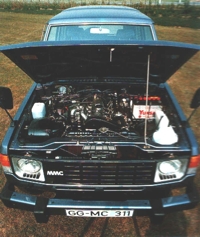
In 1983, in the Pajero's early days, the engine range was anything but lavish. Just two engines were available: a diesel and a petrol.
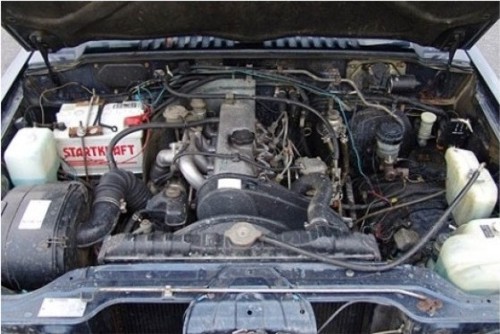
The diesel engine with the factory code "4D55" was built and delivered with a grey cast iron block and a light-alloy head. One highlight of the engine (as with the petrol unit) is a pair of counter-rotating balance shafts that absorbed engine vibrations. They are mounted at the top right and bottom left as seen in the direction of travel. Diesel Kiki was the name of the company that supplied the injection pump, a Bosch licensed design. Throttling pintle injectors are responsible for filling the swirl chamber, and an exhaust turbocharger from Mitsubishi Heavy Industries provides the right "boost" when you step on the accelerator. The valves are controlled via an overhead camshaft connected to the crankshaft by a toothed belt. With a bore of 91.1 mm and a stroke of 90 mm, the diesel engine's cylinder is laid out almost square; total displacement is 2346 cm³, and the compression ratio of 21:1 makes for lively performance figures. At just 4200 rpm the engine unfolds its full potential, namely 84 hp; measured against that, the 175 Nm of torque arriving at a relatively high 2500 rpm is a disappointment. During its production run the diesel engine frequently struggled with thermal problems; blown cylinder head gaskets were the order of the day.
The second block in the programme was the petrol engine, likewise built with a grey cast iron block and light-alloy head, with a displacement of 2555 cm³. It too benefited from the two balance shafts, mounted in the same location. In contrast to the diesel, the petrol engine drove its likewise overhead camshaft via a robust chain that engages the crankshaft directly. Filling the combustion chambers is handled by a downdraught two-stage carburettor, and ignition takes place via a contact-controlled transistor ignition. Bore and stroke of the cylinder both measure 98 mm, so the engine is designed for torque. And that shows in the 192 Nm delivered at the same engine speed as the diesel, namely 2500 rpm. Its power output also outstrips the diesel, by 19 hp, since the 2600 petrol engine mobilises 103 hp at 4500 rpm.
In 1987 it happened: the engines of the Pajero family got offspring. The petrol engine was left unchanged, but it was given a regulated catalytic converter which did not reduce its output but pushed the rated engine speed up by 500 rpm. From then on the 2600 engine delivered 103 hp at 5000 rpm. Torque, however, suffered under the clean-up man in the exhaust tract and dropped to 183 Nm. In practice this difference was imperceptible, for the uncleaned Pajero reached a top speed of 144.7 km/h versus 144.4 km/h for the cleaned one. The acceleration figures too, at 16.4 s without cat and 16.6 s with cat, lie in ranges that can be neglected. On the diesel side there were more far-reaching changes. The displacement was bored out to 2.5 litres, and from then on the engine delivered 201 Nm at 200 rpm. Power output, however, remained unchanged. The stroke increase did the performance of the diesel-engined Pajero a world of good, for the Pajero accelerated rigorously upwards from the depths of the rev range.
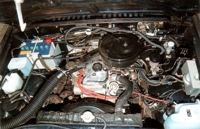
1989 saw the final change to the L040 series. The 2600 engine was superseded, replaced by a contemporary unit, namely the "6 G 72", a V6 turbo engine with 3 litres of displacement. The angle of the cylinder banks, each of which houses a toothed-belt-driven camshaft, is 60 degrees. Bore and stroke, at 91.1 mm and 76 mm, turned out rather short-stroke, and the compression ratio of 8.9:1 allowed the engine to run on regular petrol. Like the 2600 engine, the engine delivers its maximum torque at 3000 rpm and its maximum power at 5000 rpm, but in different dimensions, for it mobilises 144 hp and 225 Nm of torque. The carburettor had to give way to a cylinder-selective, electronically controlled fuel injection system and the ignition system to a contactless mapped ignition. In contrast to the 2600 engine, which was dropped, the diesel got a big brother that likewise displaced 2500 cm³. But it was additionally equipped with an intercooler, which helped the diesel engine to 95 hp - 11 hp more - at the same engine speed and raised the torque to 135 Nm at 200 rpm. This revision benefited not only the performance but also fuel consumption, which at 12.5 l/100km came in distinctly lower than the previous 13.1 l/100km. The intercooled Pajero can still be recognised today by the enormous air scoop in the bonnet.
Drivetrain of the L040
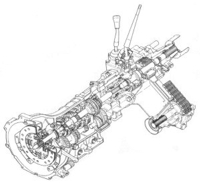
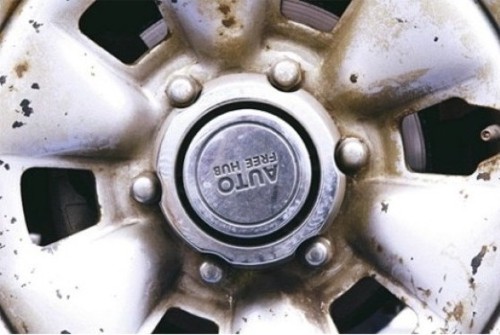
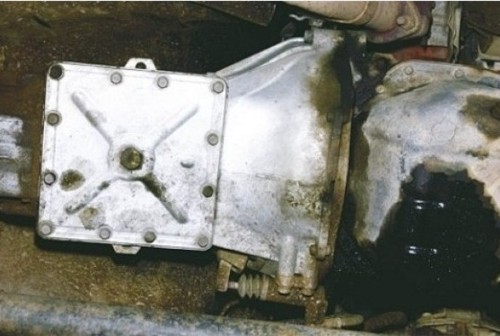
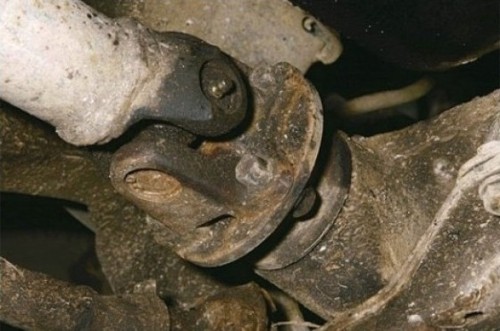
Between 1983, the year the Pajero was introduced, and 1987, precious little changed in the Pajero's drivetrain technology - in fact, nothing at all. The Pajero L040 was delivered with a five-speed gearbox and a hydraulically assisted clutch. Attached to the manual gearbox is the reduction gearbox, which when needed changes the ratio to 1.944:1 and thus delivers almost twice the force to the wheels. Flanged to this in turn was the transfer case, which via a robust chain drive directs half of the drive power to the front axle. The Pajero does without a centre differential. For this reason, the four-wheel drive of the Pajero L040 is not suited to use on paved roads. Due to the different distances travelled by the front and rear axles, enormous wind-up would occur in the drivetrain. A highlight that the road cowboys appreciate greatly (and the off-road fanatics despise in equal measure) are the automatic free-wheeling hubs on the front axle. The free-wheeling hubs make it possible to decouple the front drive from the wheels, so that the front wheels do not passively turn the drive axles, which reduces wear considerably. When four-wheel drive is engaged, the hubs lock in through the movement of the drive shafts and the wheels are supplied with drive power. If, however, you reverse off-road, the free-wheeling hubs disengage again and the car has only rear-wheel drive when moving forward once more, until the hubs lock in again. For this reason the free-wheeling hubs are the first thing the ambitious off-roader replaces on the Pajero, usually with manual free-wheeling hubs. In 1987 Mitsubishi suddenly offered a four-speed automatic gearbox of the latest design, which however was only available in combination with the long high-roof version of the diesel-powered Pajero. Yet half a year later it disappeared from the range again due to insurmountable calibration difficulties.
Suspension of the L040
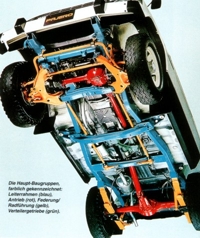
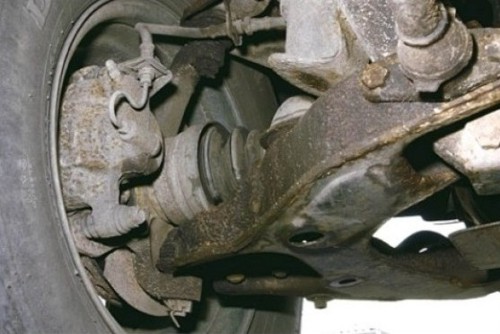
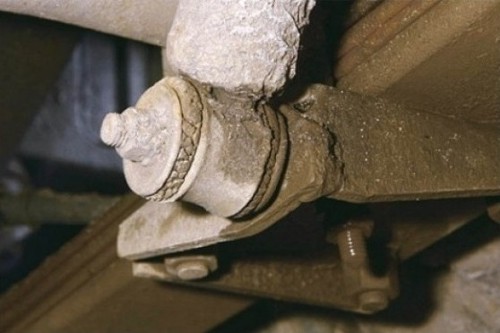
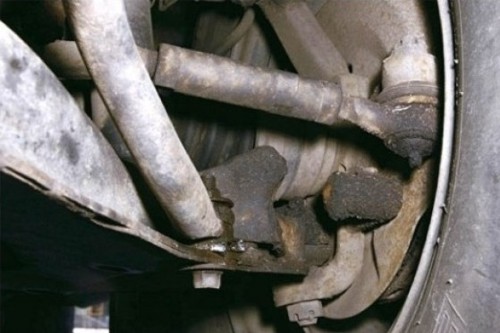
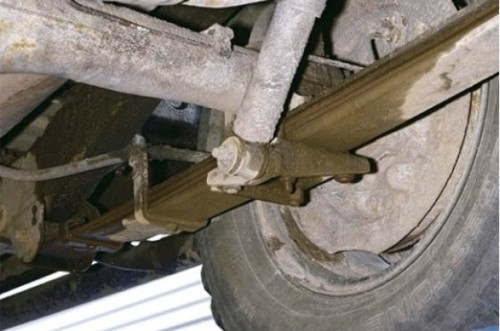
As with the drivetrain, nothing changed on the Pajero's chassis for a long time. With its suspension technology, extraordinary for an off-roader, it was considered ahead of its time anyway. At the front axle the Japanese engineers installed two stacked wishbones connected by a massive wishbone brace. A torsion bar spring was attached to each of the lower wishbones, which made it possible to raise and lower the ride height of the chassis at the front. The shock absorbers were likewise attached to the lower wishbones and braced against the ladder frame. In addition, two internally ventilated disc brakes were fitted to the front axle to give the Pajero the necessary stopping power. At the rear a rigid axle was used, combined with leaf springs. Added to this were two shock absorbers mounted in opposite directions. At the rear the Pajero braked with two load-dependent adjustable drum brakes. While the front axle seemed futuristic by the off-roader standards of the day, tried-and-tested, robust technology was used at the rear axle. The success of this combination was underpinned by the comfort and the victories at the Paris-Dakar. In 1989 the era of leaf springs was over, at least in the petrol version and the intercooler models of the diesel line, and so the Mitsubishi engineers swapped the old steel planks for modern coil springs, once again breaking new ground in off-roader chassis technology. Oddly enough, the old diesel without intercooler had to do without the new chassis package. Presumably Mitsubishi considered the diesel the workhorse among the Pajeros and left it the leaf springs for the sake of payload and trailer nose weight.
Body of the L040
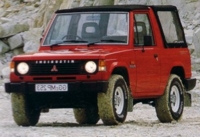
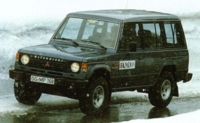
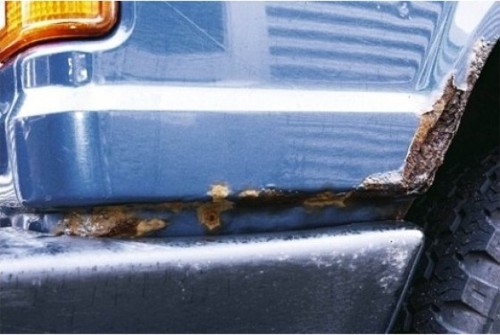
At the beginning of the Pajero story, just two body variants rolled through the land. Both with a short wheelbase, one with a steel roof, the other with a bikini top. Like all later Pajeros of the L040 series, the sheet metal rested on a steel ladder frame of the "indestructible" variety, and was mounted to it with rubber bushings. In 1985 the two short ones were joined by two long ones. Both were delivered with a steel roof, but in two variants, namely high roof and flat roof. In addition, the radiator grille was subjected to a design measure in this model year. Where previously a huge Mitsubishi lettering with a Mitsubishi emblem on the left-hand side adorned the front view, after the design change it was only the three diamonds in the middle of the radiator grille. In 1989 the last and by far smallest change to the Pajero's body shape took place. The diesel engine's intercooler required somewhat more air than the body shape supplied, so without further ado a huge air scoop was stamped into the bonnet, by which all intercooler models could be recognised from then on. The L040 series never received a facelift and never needed one. If you believe this claim is not entirely true, then let it be said that the wheel arch extensions often seen on the intercooler and V6 models were never supplied ex works.
Equipment of the L040
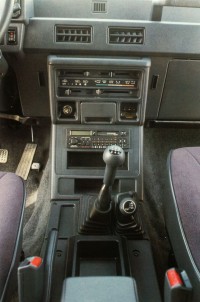
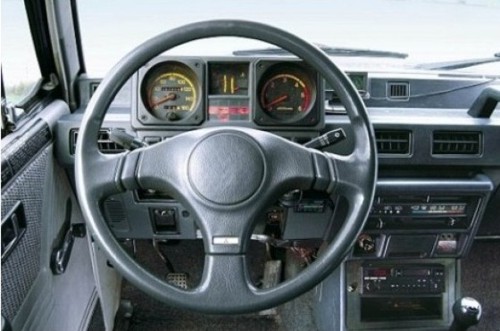
The Pajero's equipment was positively lavish by the standards of the day. A headlight washer system and a spare wheel cover were standard on the Pajero. The list continued with underbody protection plates at the front (certainly a necessary measure given the independent suspension), power steering, a rev counter, a lockable fuel filler cap, halogen headlights, a visual indicator for four-wheel-drive operation, a warning signal for doors not fully closed, tinted windows, reversing lights on both the driver's and passenger's side, as well as grab handles for all seats. Given the standards of the time, the Pajero was a paragon of comfort, especially where the off-roader sector was concerned. For the 1987 model year the Pajero also received a revision of its instruments. The design of the speedometer and rev counter was reworked, after which they no longer looked as clunky as before. In addition, the storage tray between the two front seats was replaced by a fully-fledged centre console with storage compartments and a lidded compartment.
Technical Data of the L040
|
||||||||||||||||||||||||||||||||||||||||||||||||||||||||||||||||||||||||||||||||||||||||||||||||||||||||||||||||||||||||||||||||||||||||||||||||||||||||||||||||||||||||||||||||||||||||||||||||||||||||||||||||||||||||||||||||||||||||||||||||||||||||||||||||||||||||||
Used Car Tips