V20
General Information
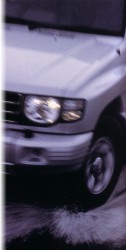
In 1991 the long-awaited successor to the Pajero L040 arrived on the market, namely the Pajero V20. Despite its new and considerably rounder design, familiar old components were at work beneath the sheet metal. But not everything was old hat. The drivetrain technology, for example, represented a huge step forward. The new Pajero could boast accessories such as disc brakes all round, ABS and permanent four-wheel drive. The old Pajero had grown up to the standards of the day and adapted itself to the demands of the road. Off-road, on the other hand, the Mitsubishi developers collected minus points. The Pajero came out lower and wider, and the chassis offered even less axle articulation than its predecessor. The weight also rose by 300 kg for the convertible version alone, the lightest one. The engines received only a minor revision and provided marginally more power. All in all, the Pajero developers took the next logical step and did not develop a new Pajero, but instead ironed out some old flaws to adapt the car to the demands of the time.
Engine of the V20
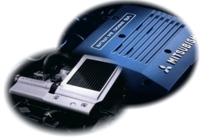
At the start of the Pajero V20 series in 1991, not much had changed in the Pajeros' engine line-up. The diesel got a larger intercooler and a new turbocharger turbine. As a result the engine mobilised 4 hp and 5 Nm more power and torque respectively, still at 4200 rpm and 200 rpm respectively. The petrol engine was likewise only slightly refined. It delivers 150 hp at an unchanged 5000 rpm. Torque increased to 336 Nm, but this was bought with a jump in engine speed from 3000 to 4000 rpm.
In 1994 Mitsubishi sent the Pajero into the race with new engines. The four-valve wave was sweeping across the car industry, and the manufacturer with the three diamonds did not stand idly by either, launching a new engine with precisely this technology onto the market. The Pajeros with the new powerplant are adorned with the lettering "DOHC-24 V6 3500". Translated that means: two overhead camshafts, 24 valves (4 per cylinder), 6 cylinders and 3500 cm³ of displacement. All of this delivers 153 kW/208 hp at 5000 rpm and 300 Nm at 3000 rpm. The power increase was achieved by enlarging the cylinder bore by 1.9 mm and fitting a crankshaft with 9.8 mm more stroke. To give the package the right seasoning, Mitsubishi reached into the parts shelf and conjured up the 24-valve cylinder head of the all-wheel-drive sports coupé 3000 GT, which was promptly installed. The cylinder banks still sit at a 60-degree angle to each other, but they were given a variable intake manifold that improved the turbocharger's charging effect, so that the engine gets more torque at low engine speeds and more power at high ones. The compression ratio was raised to 9.5:1 and demanded super unleaded as its fuel. Alongside the 24-valve 3500 engine, the aged 3000 engine was allowed to live on, though not for very long.
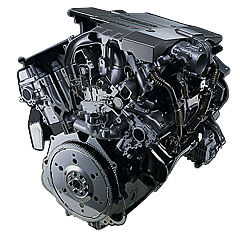
There was news on the diesel front too. The 2500 engine got a big brother, the 2800 TD engine. This engine, however, was not a simple revision as with the petrol models, but a new development that the Mitsubishi developers pulled out of the drawer to match the higher weight of the new Pajero. The engine, christened "4M40", featured substantial new developments for the most part. One thing that remained in common, however, was the swirl chamber principle, though in the new engine it was coated with ceramic to reduce temperature peaks. On the 2800 engine the toothed-belt drive of the camshafts was also finally abolished and, as on the petrol engine, the more expensive chain drive version was preferred. The new diesel represents an improvement over the old one. It may not possess the refinement and smoothness of the old unit, but in return it offers 92 kW/125 hp at 4000 rpm and 292 Nm of torque. The difference between the diesel powerplants also shows in acceleration and top speed: a top speed of 156 km/h for the 2800 versus 141 km/h for the 2500, and acceleration from 0 to 100 in 16.6 s for the big one compared to 22.1 s for the small one, speak a clear language. The consumption of the two, however, does not differ significantly: the small one uses 13.2 litres per 100 km, the big one 0.2 litres more. With these figures it joins the ranks of Mitsubishi's high-revving diesel engines.
In 1995 the Pajero with the 3000 engine briefly disappeared from the scene, only to reappear a little later bearing the designation 3000 V24. What had happened? The Mitsubishi engineers had without further ado treated the small petrol engine to a cylinder head with four-valve technology, thus boosting it to 133 kW/181 hp at 5500 rpm and 255 Nm at 4500 rpm.
Drivetrain of the V20
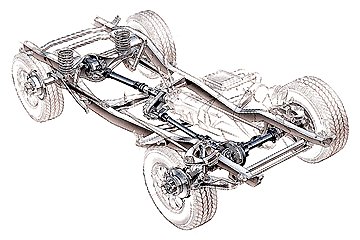
The drivetrain technology was probably the greatest challenge for the Pajero developers, for what the people at Mitsubishi delivered no longer had much in common with the familiar components of the L040. What the engineers developed in their quiet back room was later christened "Super-Select 4WD" by the group's marketing department, and there is plenty to choose from. The familiar rear-wheel drive survived the generation change unscathed, and the automatically disengaging free-wheeling hubs on the front axle continue to do their job as well. Move the four-wheel-drive lever one position forward and the transmission shifts into permanent four-wheel-drive mode, distributing the drive forces 50:50 to the front and rear axles. Should circumstances require it, the centre differential could pass the drive forces on to the axles as needed via a stepless viscous coupling. All fully automatic. If these tricks no longer get you out of a jam, simply shift one position further and the transmission establishes a rigid through-drive between front and rear axle, effectively bypassing the viscous coupling to tame misdirected drive torque. Should even this measure not take hold, there is also a low-range gear reduction that has emerged victorious from many a mud battle. But Mitsubishi went one better, in the form of a rear differential lock which below 12 km/h establishes a rigid through-drive between the left and right rear wheels. Thus equipped, the Pajero managed, despite its chassis rather ill-suited to rough terrain, to leave many a scoffer astonished off-road.
Suspension of the V20
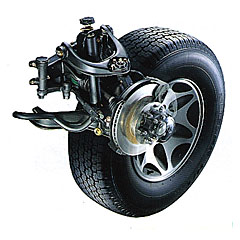
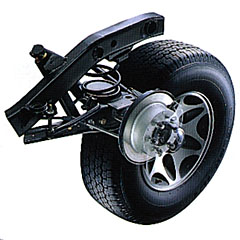
In principle, nothing changed on the chassis in the generation leap from the L040 to the V20. At the front axle, wishbones with torsion bar springs were still fitted, and the rear housed the still box-fresh rigid axle of the post-1989 L040, suspended on coil springs. When it came to safety, however, quite a lot had happened for the 1991 model year. The V20 was treated to disc brakes all round, which improved active safety many times over. Optionally, one could order an ABS braking system that went by the name "Multi-Mode" and still permitted braking with ABS even when four-wheel drive was engaged and the rear differential locked. In the more expensive GLX and GLS variants there was yet another treat, namely shock absorbers with three-stage adjustable damping, so that the Pajero could be set up entirely to one's own liking.
Body of the V20
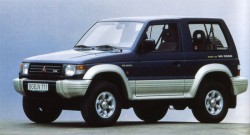
At the start, the V20 was available with 5 different bodies, which as usual were bolted onto a robust ladder frame. As with the L040 series, the V20 came as a short two-door and as a long four-door. The short one with a steel roof or as a convertible, and the long one only with a steel roof. Following the general trend, the sheet metal skins were designed more massively, and so the short Pajero, with an overall length of 4145 mm, came out 150 mm longer than its predecessor. The new Mitsubishi also grew in width by 105 mm to 1785 mm, while at the same time it became lower, "crouching" at a height of 1815 mm, 35 mm closer to the road than before. Things were no different with the long V20s. With dimensions of 4725 mm in length and 1758 mm in width, they too came out considerably larger.
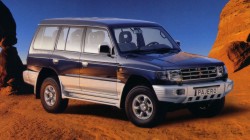
In 1998, new faces moved into the Mitsubishi dealerships. The Pajero had been prescribed a facelift, and so it was subjected to a rejuvenation treatment. The wheel arches became more angular and the side indicators were reworked. The old headlights were now replaced by representatives in clear-glass look, and fog lights moved into the front bumper. The bumper itself received a perforated strip in the middle. In addition, the transitions from the wheel arches to the sills were reworked, so that the sills now appeared to sit lower, which lent the Pajero a little more sportiness still.
Equipment of the V20
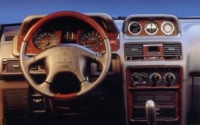
From the outset the Pajero was available in 11 different variants, which in some cases varied considerably in their equipment. Among the diesels, the line-up started with the short Pajero, available either with a steel roof or as a convertible in the GL version. It was followed by the short GLS, available only with a steel roof. The 5-door Pajero 2500TD was offered by Mitsubishi as GL, GLX and GLS. On to the petrol models. The short one was available as a convertible in the GLX trim, while the steel-roof variant came as a GLS with a choice of automatic or 5-speed manual gearbox. The long petrol version was available only in the GLS version, likewise with a choice of automatic or manual gearbox. By simple arithmetic, that makes 11. An astonishing abundance had accumulated there, when you consider that at the debut in 1983 there were just 3 versions. When the facelifted version had its market launch in 1998, all 2500 engines except for one variant had been dropped; the 2800 engine had taken the helm. At the other end of the performance scale Mitsubishi placed the 3500 engine and struck the 3000 petrol engine from its list entirely. Also new from the 1998 model year was the special edition American Dream, which Mitsubishi offered at extra cost.
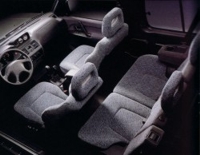
For the 1991 model year the Pajero GL offered a turbodiesel engine, the selectable four-wheel drive familiar from the L040, side impact protection, as well as fold-out armrests and four adjustable headrests. Added to this were a headlight washer system and electrically adjustable exterior mirrors. The GLX version brought all the features of the GL variant and additionally offered Super Select, ABS, adjustable damping and seat backrests with adjustable lumbar and side supports. A special feature is found in the GLX convertible version. It offers a seat memory programme with which the seat can store various settings and, at the touch of a button, readjusts itself to the respective driver. The technology of the GLX and GLS variants was largely identical, but on looks opinions divided, for the GLS came with painted bumpers and wheel arch extensions and accordingly looked even more massive than its standard brothers. Moreover, it was the only one to offer a multimeter (inclinometer, altimeter and outside temperature).
Technical Data of the V20
| Vehicle type | 3-door, 3500 GDI | 3-door, 3200 DI-D | 3-door, 2500 diesel | 5-door, 3500 GDI | 5-door, 3200 DI-D | 5-door, 2500 diesel |
| Engine | ||||||
| Number of cylinders | 6 | 4 | 4 | 6 | 4 | 4 |
| Displacement (cm³) | 3.497 | 3.200 | 2.477 | 3.497 | 3.200 | 3.200 |
| Power (kW/hp) at rpm | 149 / 202 at 5,000 | 121 / 165 at 3,800 | 85 / 115 at 4,000 | 149 / 202 at 5,000 | 121 / 165 at 3,800 | 85 / 115 at 4,000 |
| Torque (Nm) at rpm | 318 at 4,000 | 373 at 2,000 | 240 at 2,000 | 318 at 4,000 | 373 at 2,000 | 240 at 2,000 |
| Chassis/steering | ||||||
| Wheel rim size | 7.0JJ x 16 | 7JJ x 16 | 6JJ x 16 | 7JJ x 16 | 7JJ x 16 | 6JJ x 16 |
| Tyre size | 265 70 R 16 | 265 70 R 16 | 235 80 R 16 | 265 70 R 16 | 265 70 R 16 | 235 80 R 16 |
| Braking system | ||||||
| Dual-circuit braking system | yes | yes | yes | yes | yes | yes |
| Brake booster | yes | yes | yes | yes | yes | yes |
| Brake proportioning valve | yes | yes | yes | yes | yes | yes |
| Front brakes | discs | discs | discs | discs | discs | discs |
| Rear brakes | discs | discs | discs | discs | discs | discs |
| Dimensions | ||||||
| Wheelbase (mm) | 2.545 | 2.545 | 2.545 | 2.780 | 2.780 | 2.780 |
| Turning circle (m) | 5.3 | 5.3 | 5.3 | 5.7 | 5.7 | 5.7 |
| Overall length (mm) | 4.315 | 4.315 | 4.295 - 4.315 | 4.830 | 4.810 - 4.830 | 4.810 - 4.830 |
| Overall width (mm) | 1.895 | 1.895 | 1.885 - 1.895 | 1.885 - .1895 | 1.885 - 1.895 | 1.885 - 1.895 |
| Overall height (mm) | 1.845 | 1.845 | 1.845 | 1.855 | 1.855 | 1.855 |
| Ground clearance (mm) | 235 | 235 | 235 | 235 | 225 | 235 |
| Doors | 2 + tailgate | 2 + tailgate | 2 + tailgate | 4 + tailgate | 4 + tailgate | 4 + tailgate |
| Seats | 5 | 5 | 5 | 7 | 7 | 7 |
| Weights | ||||||
| Kerb weight (kg) | 1.955 | 2.000 | 1.880 - 1.950 | 2.070 - 2.110 | 2.125 - 2.125 | 2.070 - 2.120 |
| Gross vehicle weight (kg) | 2.515 | 2.510 | 2.510 | 2.760 | 2.810 | 2.760 |
| Performance/consumption | ||||||
| Top speed (km/h) | 185 - 190 | 170 | 150 | 185 - 190 | 170 | 150 |
| Acceleration 0-100 km/h (sec) | 10.0 - 11.7 | 11.5 - 13.2 | 17.1 | 10.7 - 12.5 | 13.5 - 14 | 18.2 |
| Fuel type | Super | Diesel | Diesel | Super | Diesel | Diesel |
| Fuel consumption, urban (l/100 km) | 16.8 - 19.5 | 12.0 - 12.1 | 13.0 - 13.4 | 16.8 - 19.5 | 13.5 - 14.0 | 13.0 - 13.4 |
| Fuel consumption, extra-urban (l/100 km) | 10.5 - 11.1 | 7.8 - 8.0 | 8.9 - 9.2 | 10.5 - 11.1 | 8.4 - 8.7 | 8.9 - 9.2 |
| Fuel consumption, combined (l/100 km) | 12.8 - 14.2 | 9.3 - 9.5 | 10.4 - 10.8 | 12.8 - 14.2 | 10.3 - 10.7 | 10.4 - 10.8 |
| Fuel tank capacity (l) | 71 | 71 | 70 | 90 | 90 | 90 |