Pajero V80
General Information
The time had finally come: Mitsubishi at last lifted the long-guarded secret and pulled the covers off its two novelties at the Paris Motor Show, which both the trade press and the public had been eagerly awaiting: In the exhibition halls of Porte de Versailles, at the end of September, the new Pajero and a concept study of the second Outlander generation celebrated their first public appearance. Both models will roll out to dealers in spring 2007. And the wait was worth it.
For 25 years the Mitsubishi Pajero has been regarded as an icon of luxurious off-roaders, as a reliable companion, but also as a useful workhorse. This is shown not least by the customer profile of the roughly 2.5 million Pajero drivers worldwide. One in five of them drives their Pajero daily on unpaved tracks, be it for example on large construction sites or in forestry. Four out of five Pajeros, regardless of whether three- or five-door, carry a tow hitch. Boat and horse owners appreciate the comfort and the high pulling power of the rugged Mitsubishi.
Designers and developers set themselves a very clear goal for the new generation of the Pajero: evolution instead of revolution. Improve where there was something to improve. But everything good and proven was to be retained. This also clearly reflects the wishes of the customers. They want the Pajero as a Pajero, as a genuine four-wheel-driver that feels just as much at home in heavy terrain as on asphalt roads or on the boulevards of the big cities, and that in this environment sets the standards of its class in terms of equipment, safety and ride comfort.
Drivetrain of the V80
For the Pajero's drivetrain, Mitsubishi stuck with the tried and tested, the four-wheel-drive system "Super-Select-4 II". Freely translated: The car offers the right drive mode for every terrain condition. For everyday use, the permanent variable four-wheel drive is recommended. In the Pajero this is called 4H. While driving (up to 100 km/h) the driver can switch to rear-wheel drive (2H); the front axle then runs along freely. If one axle spins, the viscous coupling locks the centre differential. On particularly slippery ground, 4HLc helps out. The centre differential distributes the power 50:50 to the front and rear axles. In heavy terrain you select the 4LLc setting, where the extremely short off-road gear reduction is engaged. New is that in this 4LLc setting the differential at the rear axle can be locked electronically at the touch of a button. With the Super-Select 4 II the Pajero has a range of further driving and safety features at its disposal. These include the MATC traction control system, the MASC electronic stability programme, the ABS anti-lock braking system, and the EBD electronic brake force distribution. Furthermore, the Pajero's extensive safety package includes both front and side airbags in front, and curtain airbags for the first and second row of seats.
Engine of the V80
New is the four-cylinder diesel engine. The distributor injection pump used up to now is replaced by state-of-the-art common-rail high-pressure technology with multiple injection. This not only meets the stricter Euro 4 emissions limits, but the engine also runs 15 percent quieter, smoother and with less vibration. Depending on the type of gearbox, power and torque have increased. The 3.2 DI-D, in combination with the manual five-speed gearbox, has 160 hp and 281 Newton metres; in conjunction with the five-speed automatic it is 170 hp and 373 Nm. A diesel particulate filter (DPF) is standard.
Confident driving dynamics are also promised by the six-cylinder petrol engine, newly designed from the ground up. It is a V6 with 3.8 litres of displacement and variable valve timing (MIVEC). Its output will be 250 hp.
Body of the V80
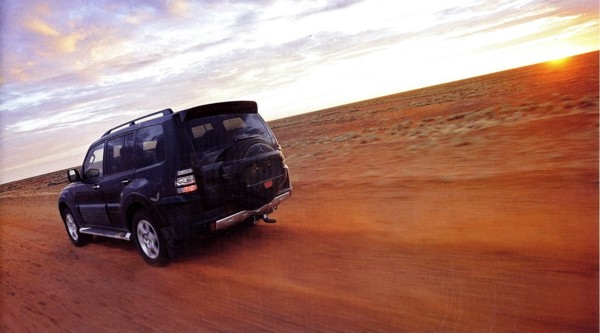
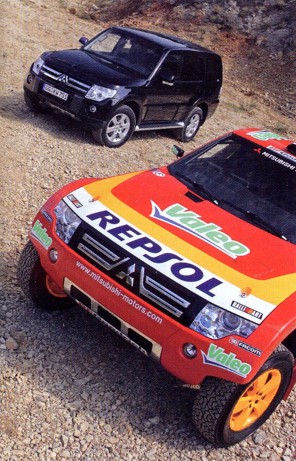
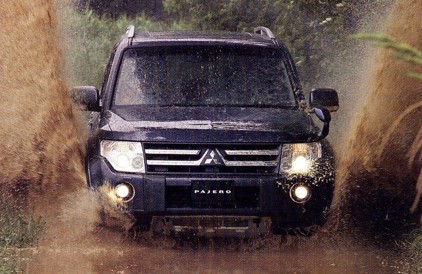
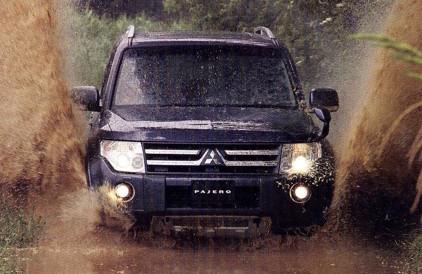
Even visually, the new Pajero emphasises its traditional and distinctive lines, for example with the steep, almost flat windscreen or its tall build. Although Mitsubishi's development maxim for the new Pajero was "evolution instead of revolution", over 70 percent of the parts of the Japanese off-road legend are new developments. Among other things, the front, rear and wings received a new design; in the body area only the roof and the doors are carried over from the predecessor. A look at the "face" of the Pajero unmistakably conveys dynamism and shows impressively: the rally version MPR13 could just as well pull up here. Very similar are the course of the chrome bars in the grille, the shape of the clear-glass headlights and the distinctive Mitsubishi logo in the centre. Beneath each of the headlights, powerful round fog lamps sit in the bumper. They give the Pajero a confident and unmistakable appearance. New are the indicators integrated into the side mirrors and the tail lights under clear glass.
Relaxed driving and a good view are promised by the pleasant, high seating position in the Pajero. The pronounced bolsters both in the backrests and in the seat cushions provide firm lateral support. In the second row, too, the Mitsubishi off-roader offers lounge-like atmosphere. The passengers enjoy exceptionally generous amounts of space.
Equipment of the V80
Mitsubishi also complied with the emphatic customer wish for a rear door instead of a tailgate on the new Pajero. Just as with the demand that the spare wheel must remain mounted on the rear door, which on the new Pajero is now placed centrally and protected by a hardcover.
Tradition obliges, after all. And at the same time it creates space in the luggage compartment. The versatility is exceptional. The rear seats in the second row can be folded forward separately, thus creating a huge load space with a table-flat surface without an annoying step. The load can be securely lashed down to sturdy steel eyelets. A clever idea is hidden at the back of the load compartment under the floor. In no time at all, a third row of seats can be conjured up, turning the Pajero into a seven-seater.
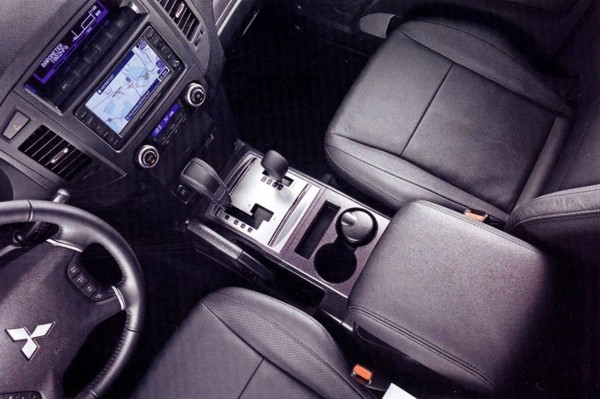
Luxury and generous space surround the occupants of the first row. The functionally designed dashboard is free of gimmicky elements. All switches and levers are placed exactly where the driver would intuitively expect them. Clearly drawn round instruments form the cockpit behind the height-adjustable four-spoke multi-function steering wheel. In the middle of the dashboard sits the 7" screen, on which, among other things, the audio programme, the navigation programme or the image from the reversing camera is displayed. Above it is a further display showing information about temperature, air pressure and compass direction.
The Mitsubishi designers showed great attention to detail on the subject of tactile quality. The materials used are of high quality. For areas such as the centre console and decorative inlays in the doors as well as the instrument carrier, surfaces in aluminium, wood and metal look or painted in anthracite are available. Very pleasant to the touch, for example, are the notched metal rotary controls for temperature and ventilation of the standard automatic climate control. Sufficient storage compartments were also thought of. Under the centre armrest is a two-tier compartment. In front of it, centrally between the seats, two cupholders sit within easy reach.
For the first time, Mitsubishi cooperated on infotainment with the renowned US company Rockford Fosgate, which installs an audio system in the Pajero that is comparable to premium European brands. It is called Rockford Acoustic Design and consists of an 860-watt system with a total of twelve speakers, operable from the steering wheel. Anyone ordering the navigation system receives a 30 GB hard drive on which every road junction in Western Europe is stored and which can also be used as a music database. In connection with the sat nav, a reversing camera is also installed.