The V60
General Information
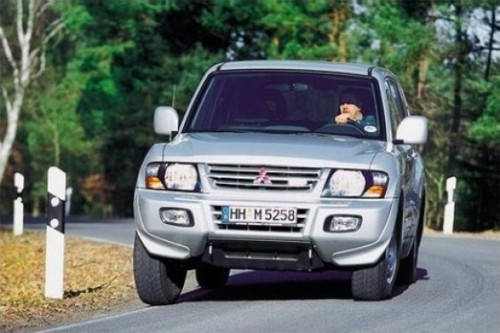
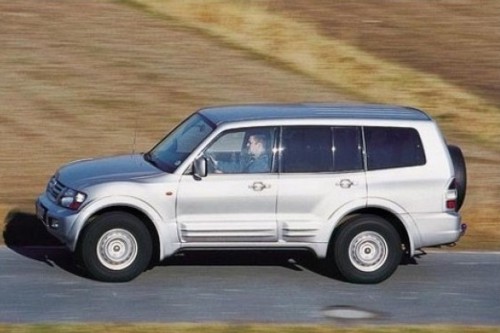
In the year 2000 the Pajero entered its third round. Anyone who saw the new one, however, had to look closely to recognise the old box from the eighties. Round and modern it comes along, not at all like the old off-roaders from the company with the three diamonds. But on closer inspection it is a Pajero, and it is the consistent further development of its predecessors. The tendency towards a wider and longer off-roader, first evident in the V20, is here taken to perfection. An overall width of 1875 mm and a track of 1560 mm speak a clear language. The new engines convince through power just as they did back in 1983, but no longer at the cost of engine speed. While the L040 and the V20 wanted to be kept happy with the throttle foot in order to drag themselves out of the mud(dle), the new engine offers insane pulling power at low revs. If you have known the Pajero since childhood, you may seem startled and wonder what is actually left of the first model. At second glance you then see the stylistically unchanged headlights, the bonnet divided into two levels, and the distinctive radiator grille, which was really only slightly reworked. Certainly everything has become rounder, but the heart of the Pajero remains recognisable. It has simply moved with the years and slowly advanced from angular prototype to chic scene-goer.
Engine of the V60
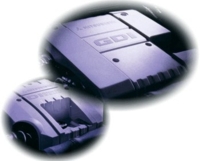
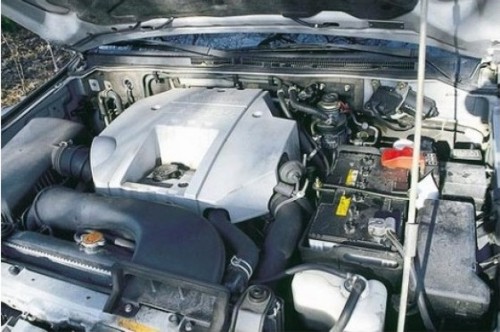
The V60 debuts with two completely new engines, utterly unlike those of its predecessor. On the one hand, Mitsubishi delivers the new one with a 3.2-litre direct-injection diesel. From four cylinders the engine draws 165 hp / 121 kW at 3800 rpm and 373 Nm of torque at 2000 rpm. With these figures it represents the most powerful engine to date and at the same time an enormous improvement in terms of power delivery. Whereas all its predecessors were high-revving specimens, this one pulls itself out of the deepest depths of the rev range with a bear-like 373 Nm. Despite the extremely high output, the new Pajero engine consumes just 9.2 litres per 100 km. In a competition held by a lubricant manufacturer, the Pajero was even driven on just 5.4 litres per 100 km. In both engines, the balance shafts familiar from the L040 are still at work to eliminate engine vibrations. Fuel injection is handled by a radial-piston distributor pump operating at a pressure of 1200 bar.
The second engine is a petrol unit equipped with the very latest technology. It is, for example, the first direct-injection petrol engine ever installed in an off-roader. It is fitted with 6 cylinders in the format 93.0 mm x 85.8 mm. At 5000 rpm the engine delivers 202 hp / 149 kW and pulls away with 328 Nm at 4000 rpm. Owing to its performance figures, the six-cylinder is considerably hungrier than its diesel brother. It imbibes 12.8 litres on average. One had better not think about what it would demand if Mitsubishi had not fitted it with fuel-saving direct injection
Drivetrain of the V60
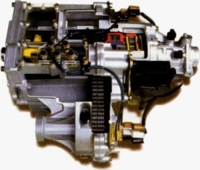
Behind the engine, too, the model change brought its innovations, but also familiar things. The gearbox was a 5-speed manual as standard; alternatively one could order a five-speed automatic with FUZZY logic, at extra cost of course. The Super Select transmission SS4-II provides, as it did on the V20, an abundance of operating modes. Starting with rear-wheel drive, through permanent four-wheel drive and four-wheel drive with locked centre differential, up to four-wheel drive with low-range reduction and locked centre differential, the Pajero provides a suitable operating mode for every occasion. Between the front and rear drivetrains, the centre differential with planetary gear set normally sends 33% of the power to the front wheels and 67% to the rear wheels. An upstream viscous brake ensures stepless power distribution on slippery ground; in addition, the centre differential can be locked completely, establishing a rigid through-drive between front and rear axle. At the rear axle, no fewer than two differential locks ensure traction: the helical gear differential automatically provides a locking effect of up to 37%, and in addition the differential can be locked 100% at the touch of a button.
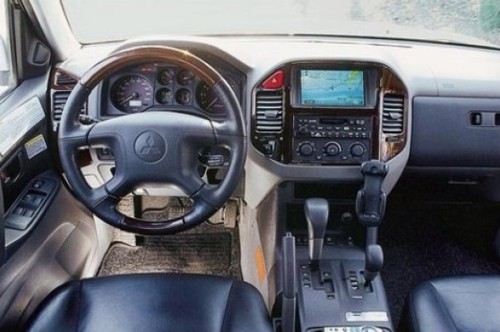
The automatic transmission Mitsubishi supplied was a high-performance gearbox of the most modern design. The system, christened INVECS-II, uses FUZZY logic control to recognise the driver's driving style and automatically adapts the shift operations to it. In practice this becomes noticeable when you compare extreme driving styles. If you drive economically, the gearbox shifts up early and from 80 km/h engages the fuel-saving torque converter lock-up clutch. Those who like to "race" experience frequently downshifting and consistently high-revving shift electronics. In addition, the Pajero with automatic gearbox can also be operated with a kind of semi-automatic mode. This makes clutching superfluous and you only have to engage the gears via the selector lever.
Body of the V60
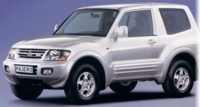
With the V60, Mitsubishi made the biggest cut in the Pajero's history: the proven ladder frame gave way to a unibody with an integrated frame. That lowered both weight and the centre of gravity and created noticeably more room inside. As usual the Pajero came as a short three-door and a long five-door, but a convertible was no longer offered. The long version stretched to around 4.78 m in length and 1.88 m in width, clearly outgrowing its predecessor.
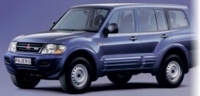
Visually the V60 appeared more modern than ever: muscular wheel arches, an upright front with clear-glass headlights and short overhangs underlined its off-road ability. A facelift followed in 2003 with a revised front end and a refreshed interior.
Suspension of the V60
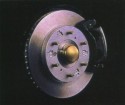
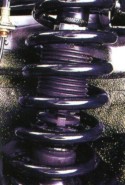
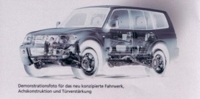
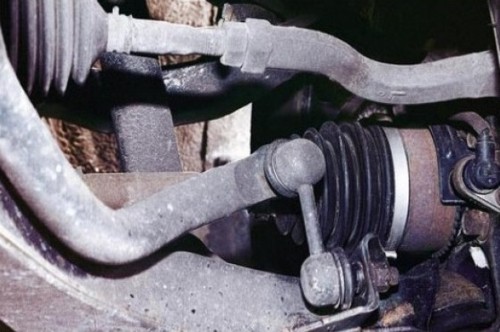
With its chassis the V60 broke with every tradition: for the first time a Pajero left the factory with all-round independent suspension. Double wishbones with coil springs guide the front wheels, while a multi-link axle replaces the previous rigid rear axle. Together with the unibody this markedly improved road holding and comfort without sacrificing off-road ability. Disc brakes all round and ABS were part of the standard equipment.
Equipment of the V60
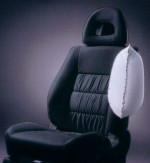
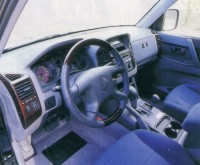
The Pajero V60 is available in three different equipment variants, ranging from the Standard to the Elegance line.
The Standard Pajero comes with side airbags as well as driver and front passenger airbags. Furthermore it offers Multi-mode ABS with EBD, height-adjustable headrests and three-point belts on every seat. Power steering with an adjustable steering column, tinted heat-insulating glazing, an illuminated luggage compartment as well as tie-down hooks and carpeting are part of the package.
with remote central locking, automatic climate control, electric windows with anti-trap protection, an RDS car radio with CD player, a power antenna and six speakers, a multi-info display as well as metallic paint.
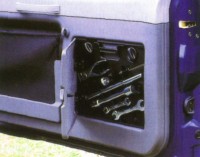
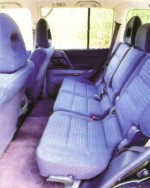
In the highest trim level, the Elegance version, further accessories are added, such as alloy wheels, wide tyres, a wood-and-leather steering wheel, fog lights, darkened side and rear windows, a height-adjustable driver's seat as well as door handles, radiator grille, exterior mirrors and bumpers painted in the body colour.
Technical Data of the V60
| Vehicle type | Pajero 3-door diesel | Pajero 3-door petrol | Pajero 5-door diesel | Pajero 5-door petrol |
| Engine/power transmission | ||||
| Number of cylinders | 4 | 6 | 4 | 6 |
| Displacement (cm³) | 3200 | 3497 | 3200 | 3497 |
| Bore x stroke (mm) | 98.5 x 105.0 | 93.0 x 85.8 | 98.5 x 105.0 | 93.0 x 85.8 |
| Compression ratio | 17.0:1 | 10.4:1 | 17.0:1 | 10.4:1 |
| Power kW (hp) at (rpm) | 121 (165)/3800 | 149 (202)/5000 | 121 (165)/3800 | 149 (202)/5000 |
| Torque Nm at (rpm) | 373/2000 | 318/4000 | 373/2000 | 318/4000 |
| Injection system | Direct-injection diesel | Petrol direct injection | Direct-injection diesel | Petrol direct injection |
| Alternator (V/A) | 14/125 | 12/125 | 14/125 | 12/125 |
| Battery (V/Ah) | 12/80 | 12/65 | 12/80 | 12/65 |
| Gearbox | 5-speed manual gearbox | 5-speed manual gearbox | 5-speed manual gearbox | 5-speed manual gearbox |
| Free-wheeling clutch in the front axle | yes | yes | yes | yes |
| Super Select 4WD-II four-wheel drive, front axle drive mechanically selectable | yes | yes | yes | yes |
| Rear axle differential lockable up to 100% | yes | yes | yes | yes |
| Chassis/steering | ||||
| Front suspension | Independent suspension on double wishbones, coil springs, telescopic shock absorbers, anti-roll bar | Independent suspension on double wishbones, coil springs, telescopic shock absorbers, anti-roll bar | Independent suspension on double wishbones, coil springs, telescopic shock absorbers, anti-roll bar | Independent suspension on double wishbones, coil springs, telescopic shock absorbers, anti-roll bar |
| Rear suspension | Multi-link independent suspension with coil springs, telescopic shock absorbers, anti-roll bar | Multi-link independent suspension with coil springs, telescopic shock absorbers, anti-roll bar | Multi-link independent suspension with coil springs, telescopic shock absorbers, anti-roll bar | Multi-link independent suspension with coil springs, telescopic shock absorbers, anti-roll bar |
| Wheel rim size | 7 JJ x 16 | 7 JJ x 16 | 7 JJ x 16 | 7 JJ x 16 |
| Tyre size | 265/70 R 16 | 265/70 R 16 | 265/70 R 16 | 265/70 R 16 |
| Full-size spare wheel | yes | yes | yes | yes |
| Power-assisted rack-and-pinion steering | yes | yes | yes | yes |
| Braking system | ||||
| Anti-lock braking system (ABS) | yes | yes | yes | yes |
| Dual-circuit braking system | yes | yes | yes | yes |
| Brake booster and brake proportioning valve | yes | yes | yes | yes |
| Disc brakes front and rear, internally ventilated | yes | yes | yes | yes |
| Dimensions | ||||
| Overall length/overall width (mm) | 4280/1875 | 4280/1875 | 4795 | 4795 |
| Overall height (mm) | 1845 | 1845 | 1855 | 1855 |
| Wheelbase (mm) | 2545 | 2545 | 2780 | 2780 |
| Track front/rear (mm) | 1560/1560 | 1560/1560 | 1560/1560 | 1560/1560 |
| Turning circle diameter (m) | 11.2 | 11.2 | 12 | 12 |
| Ground clearance mm | 215 | 230 | 215 | 230 |
| Wading depth (mm) | 600 | 600 | 600 | 600 |
| Approach/departure angle (°) | 42.0/33.5 | 42.0/33.5 | 42.0/24.0 | 42.0/24.0 |
| Ramp breakover angle (°) | 26.5 | 26.5 | 24.5 | 24.5 |
| Gradeability (%) | 70 | 70 | 70 | 70 |
| Load compartment volume max. l | 1293 | 1293 | 1700 | 1700 |
| Weights | ||||
| Kerb weight (kg) | 1055 | 1990 | 2195 | 2135 |
| Gross vehicle weight (kg) | 2510 | 2510 | 2810 | 2760 |
| Payload (kg) | 455 | 520 | 615 | 625 |
| Towing capacity (kg) | 750 | 750 | ||
| unbraked | 750 | 750 | ||
| braked | 2800 | 2800 | 3300 | 3300 |
| Permissible vertical nose weight (kg) | 115 | 115 | 135 | 135 |
| Maximum roof load kg | 100 | 100 | 100 | 100 |
| Performance | ||||
| Top speed approx. km/h | 170 | 190 | 170 | 190 |
| Acceleration 0-100 (s) | 11.5 | 10 | 12 | 10.7 |
| Fuel consumption | ||||
| Fuel type | Diesel | Petrol | Diesel | Petrol |
| urban | 12 | 16.9 | 12.4 | 17.1 |
| extra-urban | 7.8 | 10.5 | 8.1 | 10.7 |
| combined | 9.3 | 12.8 | 9.7 | 13 |
| Fuel tank capacity | 71 | 71 | 90 | 90 |
Used Car Tips V60